XL Video and the Super Bowl XLIV Halftime Show
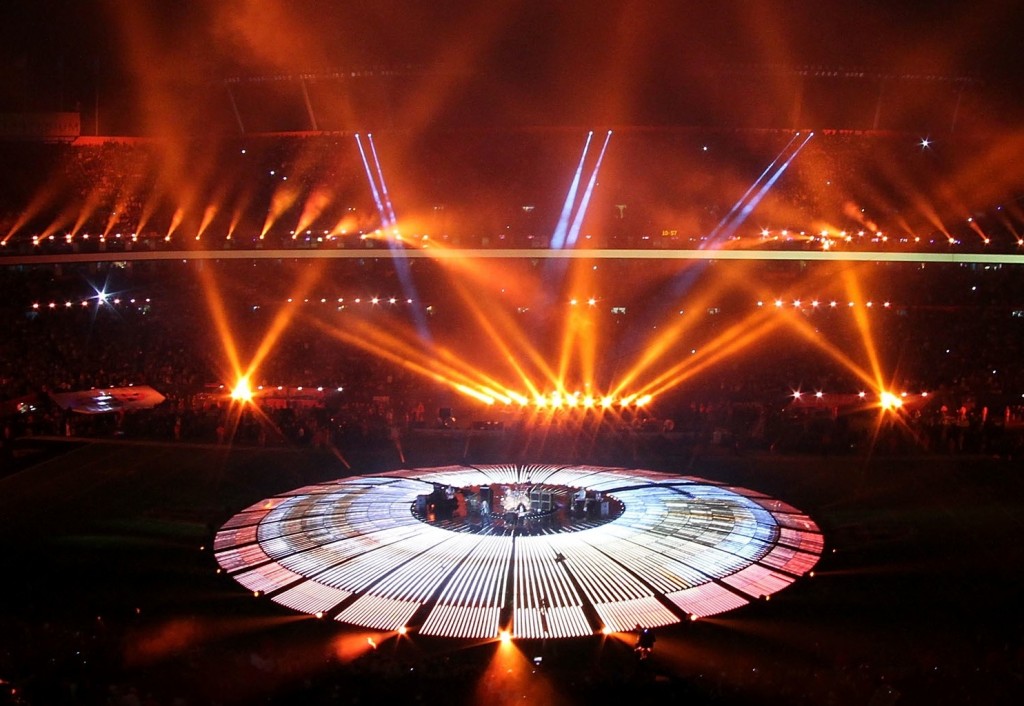
2010 Getty Images/Doug Benc
XL Video just put out a Press Release with more detailed information about how the Super Bowl XLIV Halftime Show came together. While I normally do not post about installations and events, this one is hard to pass up. If you watched the Halftime show this year and are into lighting and are like me, you were in aw of the performance. The press release gives some good insight into what was used and how it all came together. More from the press release:
How do you design a 12-minute Halftime show for The Who, one of the most iconic rock bands in the world? You push the envelope on what’s possible and exceed expectations by putting together a visual spectacle integrating LED video technology, lighting, pyro and lasers. To pull off The Bridgestone Super Bowl XLIV Halftime Show at Sun Life Stadium in Miami, described as the most intense 12-minutes in live entertainment, it takes a team effort and XL Video was proud to support the creative team by supplying gear and crew. Production Designer Bruce Rodgers, Screens/Graphics Producer Lee Lodge and Lighting Designer Al Gurdon closely collaborated on the NFL Network Production with Executive Producer Ricky Kirshner and Director Hamish Hamilton to present an unforgettable performance. “We wanted a design that felt epic; we wanted a design that felt like the band was performing for the stadium and not just the TV audience,” explained Rodgers.
Of course achieving an epic spectacle means taking a tremendous risk, especially when it is a live performance in front of thousands in attendance and millions of TV viewers. Rodgers designed a field-wide circular stage with over 3,000 Barco MiSTRIPs. “I came up with this idea to put the band on what I refer to as Captain America’s shield made out of video,” described Rodgers. “The floor is made up of 26 radial sections that surround a main stage that is made of 14-pieces.” Essentially creating a 40-piece jigsaw puzzle that 600 volunteers and crew had less than eight-minutes to move onto the field, setup, power up and go live. “It was a real example of our industry at its best; needing everybody to work together to make something big happen. All the planning, designing and meticulous attention to detail really paid off.”
For the actual video ‘shield’ Rodgers turned to XL Video to help engineer and supply 3,055 five-foot long LED MiSTRIPs, processing as well as for technical support during not only the installation but show itself. “I wanted a technology that would be nice, bright and controllable as well as weatherproof. I designed the MiSTRIP radiating from the outside going towards the middle on nine-inch centers. I worked closely with the XL team from the very beginning,” noted Rodgers. “I needed an immense amount of equipment but I also needed a completely reliable company. With XL, I could say to Ricky, ‘I have the same video company that we worked with for the Democratic National Convention. They have the technology and we know that they can make it happen.’ And they certainly did.”
XL and Rodgers did testing to confirm the choice of the MiSTRIPs and to ensure the best approach for mounting them to the stage carts as well as how to deal with the processing requirements on a sectional mobile stage. XL and Rodgers knew the most enormous challenge was the fact that the stage broke apart into 40-pieces. In order to handle the need to keep many of the most critical components powered up, XL used uninterruptible power supplies. In the staging locations, they had 110V power drops, where they would connect the UPS units to keep the batteries charged. Once the stage was brought together they had 109 connections to make for the video components alone. A daunting task in less than eight-minutes. “The goal was eight minutes; we did it in seven and a half minutes,” said Bob Magee, XL Video Account Executive and Project Manager for the Super Bowl.
There were 11 XL Video technicians underneath the stage to make connections as it was locked together. Each technician had responsibility for four carts each and XL Technical Director Mike Spencer oversaw everything in its entirety. Everybody knew each other’s role and responsibility so anybody could jump in. XL always builds in redundancy into its systems especially for live television so for a pressure-filled high-profile event like the Halftime show they had redundancy built in all the way down to the technician layer. Rodgers appreciated the coordinating planning XL put in. “All the technical guys from XL Video were like Navy Seals or ninjas. It was awesome.”
In addition to Magee and Spencer, the XL Video team included Ken Gay, XL Nashville and Lead Technician Luke Pilato. Technicians from both the LA and Atlanta XL offices included Trace Deroy; Doug Eldredge; David Imlau; Fernando Llamas; Curtis Luxton; Will Nazarowski; Steve Otten; Eric Petty; and Rod Silhanek.
Another tool XL Video supplied to both Rodgers and Lodge was the UVA d3 Show Production Suite. The d3 was used to assist in the media development and the visualization process. It helped Rodgers and Lodge present their design vision to the NFL, Kirshner and Hamilton. “We used the d3 system as a visualization tool. I often like using d3 as a communication tool,” pointed out Lodge. “It is good for the director, in this case Hamish, to see his camera angles in terms how various shots were going to work. Also it is a very good way rather than just showing a top shot; it is a really good tool to communicate a project to a client. Because we had very limited time on site we obviously did a lot of pre-visualization. I think that whole pre-viz time and understanding the template was crucial to this project.”
From demanding design to exacting execution, Rodgers and Lodge presented XL Video with one of their most challenging projects. “XL Video was exemplary really,” commented Lodge. “On this sort of project, with the amount of work that XL was doing; the amount of discussion and detail it needed communication and trust. For me, if XL is on the job, then I am feeling very confident.”
Thanks XL Video for the press release!
iSquint Podcast: Episode 6 – A Talk With Lucas Krech
 A couple of weeks ago, before the two snow storms pounded Washington, DC, I got a chance to catch up with fellow lighting designer and blogger Lucas Krech. Lucas was in town lighting a dance piece, Everyone Intimate Alone Visibly for LEVYdance. You can read the Washington Post Review of the piece as well as Lucas’s own write up on designing for the piece. The dance piece was here in DC for a week and then on to New York City for an additional week run.
Lucas and I got a chance to talk about lighting, theories and his own blog, Light Cue 23. If you haven’t had a chance, visit Lucas’s web site, www.lucaskrech.com to read some of his well though out and detailed posts about color theory, being a freelance designer and how to prepare yourself financially.
[podcast]http://isquint.net/wp-content/uploads/podcast/iSquint.net_Podcast-Episode_6.mp3[/podcast]
Friday Flickr Lighting Porn – EdForever
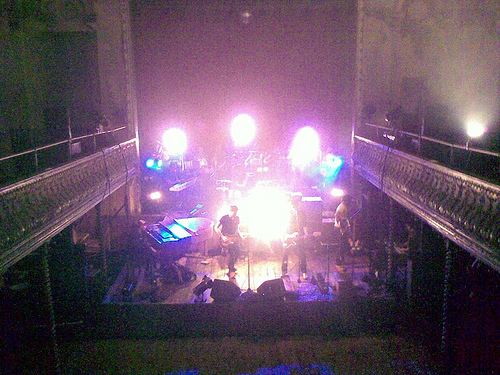
This weeks Friday Flickr Lighting Porn was randomly chosen from all of the photos added to our Flickr Pool. This weeks photos is from EdForever or Ed Warren from London England. The above photo is from a sound Check from Rumble Strips in one of England’s olderst music hall, Wilton’s Stage.
Want to see your lighting design work featured on iSquint.net? Add your photos the our Friday Flickr Lighting Porn Group.
Friday Flick Lighting Porn – Mark Wynn-Edwards
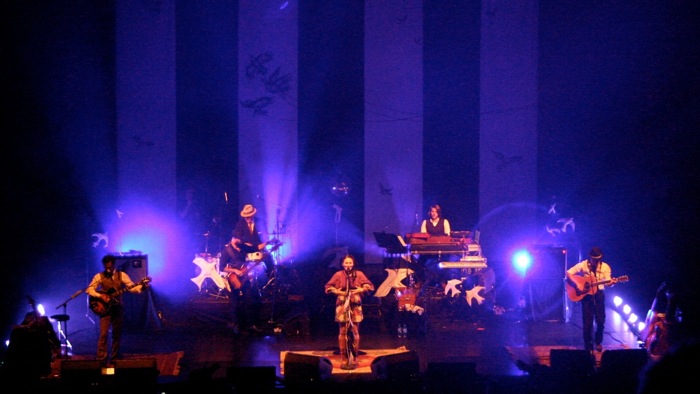
This weeks Friday Flick Lighting Porn comes from Mark Wynn-Edwards. You may know him better at @marktherockld on flickr. Mark’s photo was randomly chosen this week to be featured here on iSquint. This photo is from Mark latest tour with Emiliana Torrini. mark explains a little about what he was trying to achieve and some of the lights he used.
From the very beginning Emilianna (Torrini) had an idea of what she wanted to achieve with the lighting as this was the first time she had a lighting designer normally she used house lighting techs, but it was decided for the last tour of a one year run to bring in an LD with production.
It was decided the lights were to be cohesive with the moods of the music ,limited to generally a very earthy colour pallet with no gobo’s ( emiliana hates them) with the lighting used in a very empathetic way.
The 4 strip backdrop was used as a cyc and for the upbeat moments as emphasis using sudden splashes of colour , was also used for creating effects with the mirror balls and the moving lights.
The back drop was lit with Colour blast led fixtures. I was very impressed with the fixture for colour spread and colour mixing.
The colour blast were also used around stage to light up Backline and band again to add splashes of colour and add dramatic emphasis at key moments.
6 VL 2000 hidden behind the backine and were shooting through the Backline – as I was not able to use gobo I decided to use the shafts of light created as as light breaks through as an effect and create atmosphere – this proved very interesting as the band would have an impact on what the lighting looked like so you would get breaks in the light created with the neck of a guitar or the drummers foot for example.
For the darker sentimental moments there were 3 mirror balls lit with 5 source 4 and the VL2000 and at times the house moving lights.
FOH control was from a Jands Vista T2 ( my own) this console proved to be a real asset as house generics and moving lights were being re-patched every day but still have the same show because of its fixture patch capabilities.
Wanna see you Lighting Design work featured here on iSquint? Add you photos to our Friday Flickr Lighting Porn group. When adding images to the group, add a little bit about the show or event. Want to see more of Mark’s work or contact him, visit his website at www.markwynnedwards.com. You can also read his Where is the Industry Heading interview that he did here on iSquint as well.
Friday Flickr Porn – Romeo & Juliet
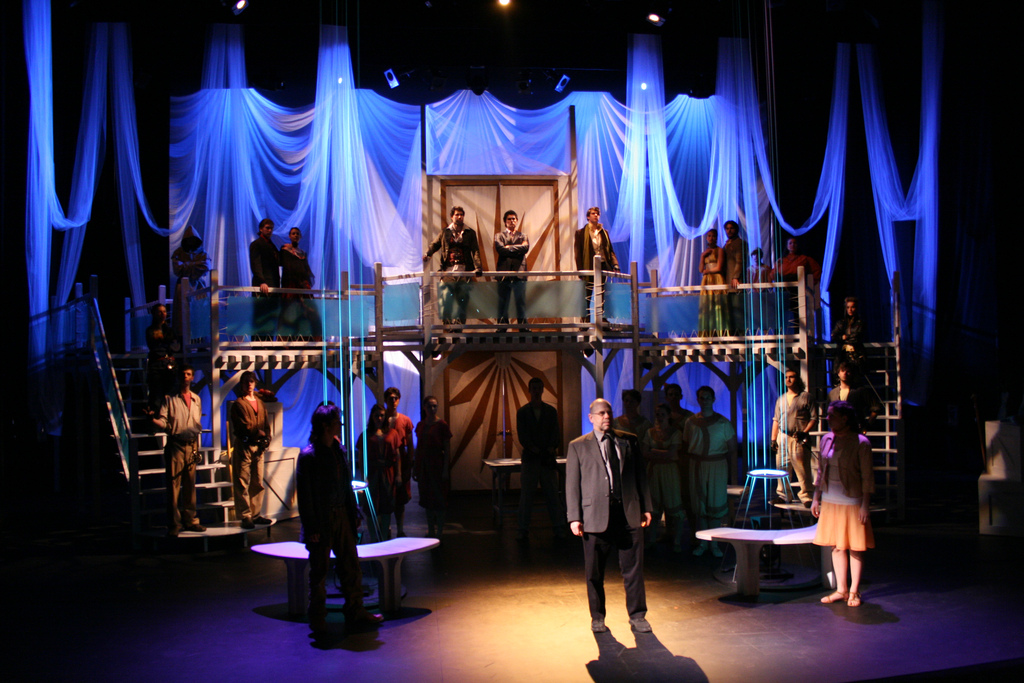
This weeks Friday Flickr Lighting Porn was randomly choosen for the images that have been added to our Flickr group by our readers. The image above is a scene from Romeo and Juliet at State University of New York – College at Fredonia that ran this past spring. The lighting designer was Todd Proffitt, the lighting and scene designer at SUNY-Fredonia. You may have also seen Todd at round the Twitterverse @tm204.
Todd Proffitt has been a freelance Lighting Designer for over 15 years. Currently, he works for the State University of New York– College at Fredonia Department of Theatre and Dance as the Associate Professor for Lighting and Sound Design. He holds a Master of Fine Arts degree in Theatre Design from Texas Tech University and a Bachelor of Fine Arts degree from Central Missouri State University. In 1999 was the recipient of The United States Institute of Theatre Technology’s Barbazon Award for Lighting Design. He has served as a lighting designer for such companies as Cortland Repertory Theatre Company, The Chautauqua Conservatory Theatre Company in Chautauqua Ny; Buffalo State College; The Paul Robeson Theatre in Buffalo Ny; The Producers Circle in New Orleans; Anglefire Mountain Theatre Group in Anglefire, New Mexico; Central Missouri Repertory in Warrensburg, Missouri; and Opera Iowa in Des Moines, Iowa. Before moving to Fredonia, Mr. Proffitt served as Interim Technical Director for Loyola University in New Orleans.
Thanks Todd for add this and some other great photos to the Flickr pool! If you want to contact Todd, you can reach him through twitter, @tm204 or through his website at www.toddproffitt.com.
Want to display your lighting design work to the world? Add your photos to our Flickr Pool. It is as simple as registering with flickr.com and then upload some photos and add them to the flickr group. Each week we randomly choose a photo from the flickr pool and feature here on iSquint on fridays.
New Book: Light Plot Deconstructed
 Towards the end of 2008, we talked with lighting designer Gregg Hillmar about his latest book, Light Plot Deconstructed. Just in the past couple of months, the book has been finalized and sent off to the publisher.
Light Plot Deconstructedis the debut work of accomplished scenic and lighting designer, Gregg Hillmar. Mr. Hillmar has developed proven methodologies for drafting light plots over his more than 15 years of experience using Vectorworks. His successful methods for designing with Vectorworks have been exhibited many times over the years, whether it was to fellow colleagues at tradeshows, or in the classroom where he has taught scenic and lighting design to many aspiring professionals at Randolph-Macon College. Light Plot Deconstructed is a great companion guide for anyone seeking to learn the fundamentals of lighting design with Vectorworks Spotlight.
Light Plot Deconstructed retails for $40 and is now ready to ship from both the books website, www.lightplotdeconstructed.com and Nemetschek website, www.vectorworks.net.
Capture Visualization Software Released for Mac
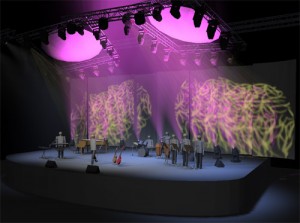 We heard through the Facebook grape vein that Capture Sweden, the makers of Capture Lighting visualization software has a new release of their software for the Mac. Captures website has confirmed it. Capture Polar is available for the Mac and included functionality from the Basic and SmartSoft editions.
Capture is a lighting design software for Windows, focusing on the creative design and documentation stages of the process. Capture allows you to work in real time with all objects without the need to switch modes or applications, allowing for maximum flexibility and creativity.
For more information, to purchase or to download Capture Polar software for Mac or Windows, visit their website at www.capturesweden.com.
Lighting Design 101 Web Event – Part II
We received a message from Creative Stage Lighting about the up coming Web Event on Lighting Design 101, Part II. The web event happens at 3:30pm (est) on April 16th. This Web Event is a follow up to Part 1 of the Lighting Design webinar which was held on February 19th.
The Webinar will be lead by the editor of PLSN, Richard Cadena. Richard is a ETCP recognized trainer, and author of entertainment lighting books such as Electricity for the Entertainment Electrician and Technician. He is joined by lighting designer Jeff Ravitz. Jeff is the lighting designer for such artist as Bruce Springsteen, the Black Eyed Peas, and Dave Matthews. Together they will cover how each other approaches the same project.
Topics include:
- Lighting instruments, positions, and purpose
- Plotting, modeling, rendering and visualization
- Color combining and scene building
- Programming and playback
For more information on this FREE Lighting Design webinar, click here. Register for the webinar now. Did you miss the first one? Subscribe to the podcast to watch the first Lighting Design webinar on your computer or other device such as your iPod.