Review: Elktralite LXE700 Spot and Wash Unit
Around the time of LDI this past year, Elektralite announced the release of their newest line of moving lights, the LXE700 Spot and Wash unit. Elektralite has started shipping units with in the US through their distributor, Group One Limited. Elektralite has been kind enough to drop off one of each unit for iSquint to do a review.
Features
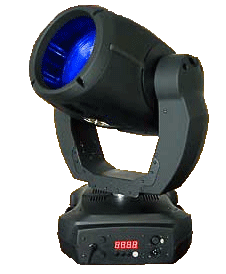 Both the Spot and Wash unit use an HSR 700/70 lamp that is running 7000 kelvin and has a lamp hour rating of 1000. Both fixtures are able to operate in either 8 or 16 bit mode which is selected via the on board menu system. But fixtures have 0 – 100% dimming through the use of a shutter that is independent of the strobing effect. This makes it possible to dim the fixture while still strobing, not a feature found in a lot of fixtures.
Both the Spot and Profile fixture feature full CMY color mixing as well as a rotating bi-directional color wheel with 7 colors plus open white. The color wheel is able to produce split colors to create interesting color effects. The colors for the color wheel were chosen by a group of leading Lighting Designers in order to give those who use the fixture some of the common colors required in a moving light.
The fixtures an on board menu system found on many moving lights. From the menu system you can address the fixture, check lamp hours used on the fixture, how many hours the fixture has been on, reset the fixture and home the fixture as well as many more common features.
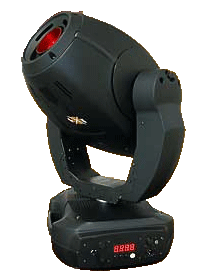 The Spot fixture has a step zoom from 24, 28 and 35 degrees. The spot fixture utilizes lens that are made from a solid piece of glass rather then the traditional layed lens that are glued together. Using these types of lens, the spot fixture does not lose the typical 15% or more light lose due to glued together lens but only loses 5-7%.
While both fixtures sport a frost wheel. What is interesting to note is that the wash unit is able to produce a “PAR Can” light beam with is Beam Shaper . The zoom optics on the wash fixture is also something to note as they use Fresnel lens with a glass reflector and are able to produce a field angle from 7 degree to 28 degrees
One of the Elektralite engineers mentioned that the the profile of the unit is set up to where the course pan and tilt are at the beginning of the profile while the fine pan and tilt are located near the end of the profile. This could cause a few headaches when controlled by an ETC lighting console as they like to see course and fine pan and tilt next to each other. Elektralite is able to send a custom profile for units purchased that will be controlled by ETC consoles.
Both the Wash and Profile units are well priced in the market at $4,499.00 and $5,499.00 respectively. With the features packed into both fixtures they are well suited to attack the 700 line up of movers in the current market. Visit www.myelektralite.com for more information on the LXE700 series of fixtures and to locate a dealer near you.
Review: iPhone App – Light Calc Lite
 iPhone apps are growing in numbers on the iTunes Music Store. At the current count there are over 10,000 iPhone apps available through iTunes. We have recently performed a search on iTunes for apps specific to the entertainment lighting industry and have found just a hand full off apps. Quite a few of the apps seem to do the same basic operation such as either calculating the DMX address of a fixture with dip switches or finding the beam angle of a light.
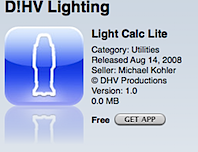
A little known app for lighting that was released in August last year has just caught our attention. Light Calc Lite by D!HV Lighting performs one operation and does it well. While this is a lite version and thus free on iTunes, it is a water down version of it’s big brother, Light Calc, which is a paid app.
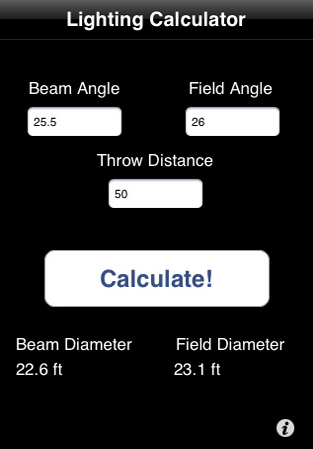
While the Light Calc Lite is a nice little free app that does what it says, the user has to have some have basic information about the lighting fixture before they can calculate the field and Beam diameter. While this information is not hard to find on a fixture manufacturers website, it is just one more step to complete the task at hand. Honestly, what do you expect for a free application?
On the other hand, the big brother app to the Light Calc Lite, the Light Calc is a paid app, it has some more advanced features included. One of these features that it has the profile information about commonly used fixtures already built into the application, thus not needing to find the information some where else.
Though reading through some of the comments left by users about the Light Calc on iTunes, the fixture library is some what lacking in fixtures and might not be worth the investment just yet. The developer has recognized this issue and is in the process of adding more fixtures to the library. No time frame has been set.
You can download the free version, Light Calc Light here from iTunes. The paid version, Light Calc can also be downloaded from iTunes here for $ 4.99.