
Winner of the 2012 Student Lighting Design Competition Is…
 Have you been waiting with bated breath to hear the announcement of the 2012 Student Lighting Design Competition? We were scheduled to announce the winner of the SLDC was March 29th, the first day of USITT. Well, it turns out this year was harder to judge than we expected. There were just so many wonderful entries the judges need additional time determine the winning.
The winner is…
Karyn Lawrence
Karyn is a student at University of California, Irvine finishing up her Masters Degree in Lighting Design. Karyn entered her design of Abraham and Isaac in Jerusalem which was a realized design and performed at the UC, Irvine Claire Trevor Theater in September of 2010.
Congratulations Karyn! Thank you to all of the students that entered the 2012 Student Lighting Design Competition! You made this a tough choice for the judges this year! We would also like to thank all of the SLDC sponsors and Judges! Look for more details for the 3rd Annual SLDC in the coming months.
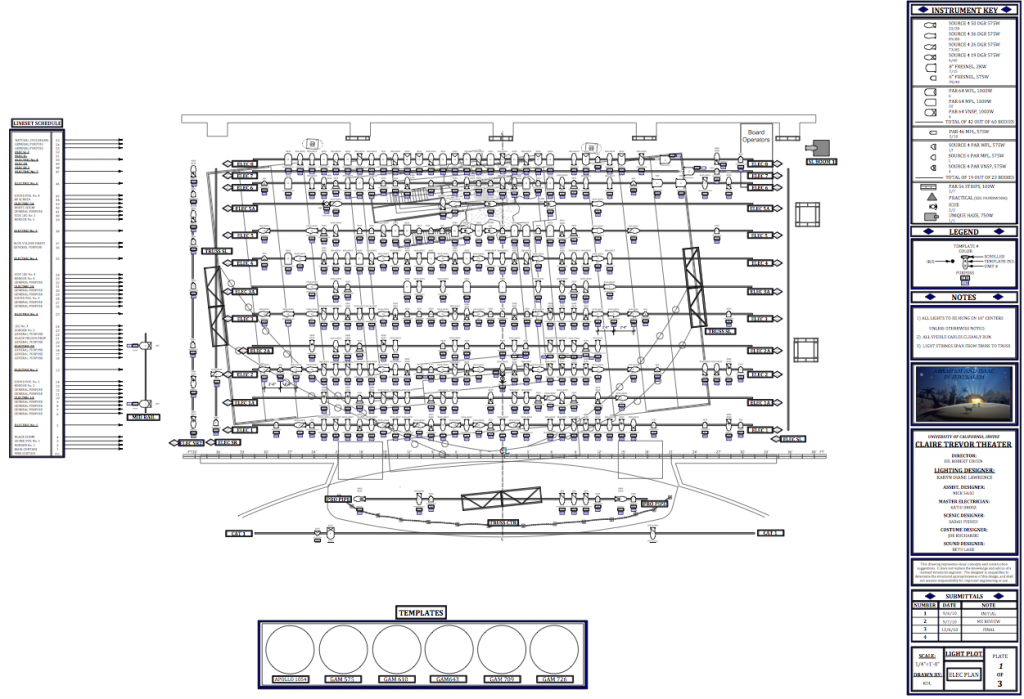
Karyn's Plot of Abraham and Issac in Jerusalem
Time is Running Out for the 2012 SLDC!!!
Hey Students, Time is running out to enter the 2012 Student Lighting Design Competition!!! You only have until this Friday to submit your designs to the SLDC. Don’t put it off till the last minute, get your entry in before the clock hits midnight on Friday!
Why should you enter… EASY, take a look at the prize package!
- Professional License of Vectorworks® 2012 with Renderworks®
- Personal license of Lightwright™ 5
- Single license of Field Templates SoftSymbols V3
- Lightplot Deconstructed
- Entertainment and Lighting Design with Vectorworks Spotlight
Before you submit your entry and design, make sure you have everything we are looking for.
After that, Submit your Design! Good luck and Break-a-leg.
Time is Running Out For the Student Lighting Design Competition
Attention all lighting design students. There is less than a month left in the Student Lighting Design Competition. March 16th 2012 is the last day for students to submit their lighting design entries to the competition.
On March 29th, at the USITT Conference and Expo in Long Beach California, the winner will be announced of the Student Lighting Design Competition.
The winner of the Student Lighting Design Competition takes away one huge prize pack. Of which is a Professional License of Vectorworks® 2012 with Renderworks®, a personal license of Lightwright™ 5, a single license of Field Templates SoftSymbols V3 and a copy of Lightplot Deconstructed.
After March 16th, we will no longer be accepting entries. Don’t put it off till the last minute. To help you along the way, there are a couple of places to get some help. Check out the SLDC Resource page. While you are working on your design, do not overlook any of the required materials for entry. Any piece of material missing from an entry will automatically be rejected from the SLDC. Don’t let one little piece of the puzzle destroy your chance of winning.
Learn more about the Student Lighting Design Competition. Once you have your design ready, submit your entry here. Good Luck and Break-a-leg!
Vectorworks Releases Entertainment and Lighting Design with Vectorworks Spotlight, First Edition
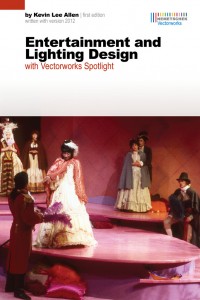 Perfect timing! If you are a student looking to enter the 2012 Student Lighting Design Competition, Kevin Lee Allen’s new book, Entertainment and Lighting Design with Vectorworks Spotlight, First Edition might just be what you are looking for! Not only in Kevin Lee Allen one of our judges for the SLDC, he is also an award-winning lighting and scenic designer whose work includes theatre, film, TV, museums and corporate environments.
More from the press release:
This book explores the use of the Vectorworks Spotlight with Renderworks® program for use in the entertainment industries. While the methods and techniques described are applicable to film, television, concerts, exhibits, and themed architecture or interiors, this tutorial focuses on a project that creates lights and a set for the stage, the root of entertainment design.
From one step beyond traditional pencil thumbnails, this guide outlines a process of design development and collaboration with other designers and technical staff. The text is tutorial-based and directs the user to create two projects, each supported by a series of simple exercises. The first project is the creation of a simple 3D form, and the second project entails the creation of a scenic and lighting design for a theoretical production of Romeo and Juliet.
This book is written for professional designers as well as designers in education (students, instructors, schools). It is intended for use with Vectorworks 2012 software and is most applicable for Vectorworks Spotlight and Designer users. It is a part of Nemetschek Vectorworks’ self-paced training options, designed for people who like to learn on their own and at their own pace. For more information and to purchase these tutorials, please visit www.vectorworks.net/training/guides.
The tutorial will also be part of the prize package for the iSquint.net and Stage Directions Student Lighting Design Competition (SLDC), sponsored by Nemetschek Vectorworks, City Theatrical and Field Template. Allen serves on the competition’s panel of judges. Entries are due March 16, 2012, and the winner will be announced at the USITT Conference on March 29. For more information and to view the complete rules.
Interview With 2011 Student Lighting Design Competition Winner – Colin Chauche
 Lat year about this time, students were cramming to get their entries completed for the 2011 Student Lighting Design Competition. Last year’s winner, Colin Chauche sat down with iSquint to talk about his experience and offers some advice to students looking to enter into the 2012 Student Lighting Design Competition.
Let this interview serve as a reminder and offer guidance on how to complete your design well before the deadline. Entries will not be accepted after the deadline which is March 16, 2012! Make sure to review the SLDC rules and requirements. If one piece of the required materials is missing, the entry will automatically be rejected. So double check your work, the requirements. Each student is only allowed one entry.
For the 2011 SLDC, Did you use a realized or none realized show for your entry?
For The Sound of Music the biggest challenges were the tight overhead space and the raked deck. Because of all of the flown elements and their size it really cut down on my options for where the electrics were placed. Fortunately the scenic designer brought this up to me in the very early stages of planning. He was very cooperative and did move a few pieced of scenery around to accommodate me but even with the concession there were some shots I couldn’t make or were just barely making it. The raked deck brought with it another series of challenges with it. Most importantly because of the load in schedule it meant we couldn’t use our man lift to focus the lights. We actually decided to purchase a focus track for the show but it also made me cut back and choose my systems more wisely. The idea was to use the movers as much as possible and cut out conventional systems to cut down on the focus time. Because the deck also had tracking scenery on it I lost any ability to use booms for the show. I was fortunate that our theater has one pipe on both SL and SR that actually runs parallel to the centerline. I used that as best we could to get some side light shots. Although for a couple of scene changes it had to get flown out and then flown back in.
What resources did you use to complete your design?
For the design contests I really only used a couple of references, none of which were online. My main reference would have to be my professors. I was fortunate enough to have classes that covered the basics of 2d drafting and 3d modeling with Vectorworks as well as how to use Lightwright 5. Going in to the design contest I already had the basics covered but when it came to specific problems or advice I turned first to my professors. Let me give Todd Proffitt and Greg Kaye thanks and a big shout out for helping me with the SLDC and many other projects. The other resources I used were Light Plot Deconstructed by Gregg Hillmar and A Practical Guide to Stage Lighting, Second Edition by Steven Shelley. Light Plot deconstructed is a great resource because it really helped focus and expedite my workflow as well as giving me some aesthetic ideas. For a drafting reference I often looked to Mr. Shelley’s book for samples of drafting because I find his style informative and easy to read. If I were doing this again I would add a few resources I wasn’t aware of like the Vectorworks Spotlight users email list to help me through difficult problems and also the drafting samples that Live Design has published.
How did the SLDC prepare you for working in the professional world?
The SLDC really did two things for me. This was the first time I had created really polished lighting renderings using Renderworks. I had made scenic renderings before but the challenges are very different when you are showing lighting looks. I think more and more there is a desire to see what the lighting is going to look like before you get in to the space and computers are some of the best ways to do this. The other thing I learned was how to make a real professional plot. I had of course made plenty of plots in class and for the shows I’d designed but they had always been tailored to our educational setting or a much more informal setting than the professional world might require. This was an opportunity to create paperwork that was truly polished and ready for the real world. (There is lots of pressure when you know people whose books you’ve red on drafting are looking at your drafting.)
What projects are you working on after school?
I’m currently the lighting design intern at Playhouse on the Square in Memphis TN where I design 8 shows in their 230 seat converted movie theater. (Elvis used to screen movies in this theater back in the day) I also assist the resident lighting designer with 8 shows in their new theater across the street. Its a lot of work but not many places will give you your own space to work in and a season of shows that includes Avenue Q, In the Next Room or the Vibrator Play and Spring Awakening. In the fall I’m planning to move to NYC where I hope to get work as an assistant as well as continuing to design.
Do you have any advice for students entering the 2012 SLDC?
My biggest piece of advice is just do it. If you are anything like the average college student you probably have some student debt and winning this is going to save you at least a grand. These are tools that almost everyone in the theater lighting world uses and you will have to get them to work professionally. This is a great opportunity; don’t let it slip away by making excuses.
I would also say, if you can, use a realized design or something you have done for class. That means you might already have some of the work started and you just have to update it or tighten up the drafting. For me it’s also a lot easier to go through the processes of designing when you aren’t also burdened by having to make up a world in which your unrealized design has to live in. That means you don’t have to come up with the theater, or the scenic design or the directors concept. These are all real things that happened and you thought through them and then implemented it.
SLDC 2012: Resources Page Added
 |
 |
||
 |
|||
 |
 |
 |
|
 |
|
|
|
It’s getting close to the holiday season! Most students have already headed home for the break. What a perfect time to start working on your Student Lighting Design Competition entry! If you have not done so already, head over to the SLDC page and download the required software, Vectorworks 2012 and the demo version of Lightwright 5.
If you are unfamiliar with the software, no worries, we have you covered. We just posted a Resource page helping you understand the software titles, how to get started and how to find help through out the SLDC. We encourage you to get started now while you are between semesters. Once the Spring semester starts, time will be limited and USITT will be here before you know it. Don’t put it off to the last minute!
2nd Annual Student Lighting Design Competition
|
|
|
||
|
|
|||
|
|
|
|
|
|
|
|
|
|
It’s back! The iSquint.net & Stage Directions Magazine Student Lighting Design Competition (SLDC) is officially underway! We are proud to welcome back our sponsors, Nemetschek Vectorworks, City Theatrical and Field Template. Starting today, students may begin to download the student version of Vectorworks 2012 and a demo version of Lightwright in order to compete in the SLDC.
The SLDC is a chance for lighting students to learn and understand the same software and design process that the professionals use. Students that enter the SLDC are judged on their knowledge of lighting design, drafting skills and understanding of the design process. The winner of this second annual competition will receive a prize package including a professional license of Vectorworks® 2012 with Renderworks® software, a personal license of Lightwright™ 5 and a single license of Field Template™ SoftSymbols V3. The winner will also be featured on iSquint.net and Nemetschek Vectorworks’ news site, Planet Vectorworks.
Design entries must be created by a student using Lightwright and Vectorworks software with Renderworks. Full-time students with active and valid college or university IDs can download a free student version of Vectorworks 2012 with Renderworks at student.vectorworks.net. (Students living outside the U.S will be redirected to a local distributor in their country to obtain a student version.) Lightwright also offers a demo version that can be used for producing paperwork for the competition, which can be downloaded at: www.mckernon.com.
Entries will be judged by a panel of industry experts including: lighting designer, writer and editor Justin Lang from iSquint; software engineer and lighting design industry expert Kevin Linzey from Nemetschek Vectorworks; author and lighting designer Steve Shelley of Field Template, developer of Soft Symbols; lighting designer, author and Vectorworks expert Gregg Hillmar; and lighting designer and developer of Lightwright, John McKernon.
Entries are due March 16, 2012, and the winner will be announced at the USITT Conference on March 29.
For more information and to view the complete rules, please visit: http://isquint.net/student-design-competition.