
Review: Field Templates RULES! English Metric & Striplight Placemat Templates
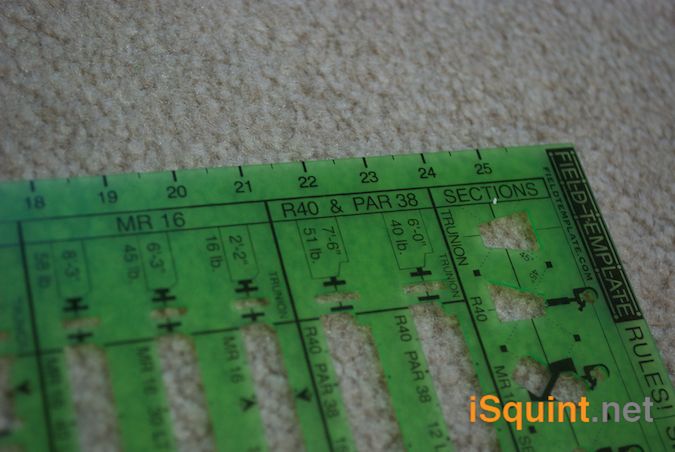
People say that the old world charms are losing out to technology in this day and age of computers and the internet. It is faster and easy these days to shoot off a quick email, text or tweet to a person to say thank you or convey a message. What use to be the standard of taking time to hand write a note and send it in the mail has quickly evaporated and turned into pounding a keyboard, some quick mouse clicks and our message is sent instantly to a persons digital mailbox.
The same thing can be said about drafting these days. With the wide assortment of computers aided Design Programs, (CAD), available to us, designing, updating and distributing our paperwork in a timely manner is just as easy. Before CAD programs, every thing was drafted by hand. It is a true form of art in it’s own right.
If Steve Shelly has anything to say about it, the art of hand drafting is not totally lost. In the past year, Mr. Shelly’s company, Field Templates has released two more plastic drafting templates to their LARGE collection of templates already available. At USITT 2010, Field templates introduced the RULES! Striplight Placemat template and at LDI 2010, they released the RULES! English Metric template.
As with all of Field Templates “stencils”, they are made of 0.30″ thick semi transparent plastic and designed specifically for entertainment lighting drafting. Field Templates does not just throw the most popular lighting symbols on to plastic and call it done. They listen to designers, user and drafters and organize specific templates for the job. From there the templates are laid out with Using the patented Pro*Trak 50 System, all of the symbols are pre-spaced 1′-6″ apart and aligned to horizontal axes (like a batten). This makes spacing and laying out your pipes quick and easy.
From there, Field Templates has added in numerous common fixture accessories and useful drafting aids to help make drafting quicker and easier. They pack a huge amount of information and guides along with the lights, accessories and guides not just cut through the plastic, but printed on the surface as well, such as scale rulers based on the scale of the template and reference points to help rotate fixtures on a pipe.
RULES! English Metric Field Template
As mentioned above, Field Templates has received a huge amount of request from designers and drafters over seas asking for metric specific templates to design with. Field templates answered their calling with the RULES! English Metric Template. What is really spectacular about the RULES! English Metric Template is that Field Templates laid out 32 fixtures and accessories not just in 1:25 scale, but repeated the 32 fixtures in 1:50 scale as well. So one template is now giving you two scales two work in! Fixture symbols that are included range from ETC, Strand, Selecon, Robert Juliat, and Reich & Vogel along with some generic striplights and moving light symbols.
Two symbols that are included in the template is a headset cut out, which I think is pretty neat, but how useful, I am not sure. The other symbol included is and electric symbol. This one confuses me a little as it was a huge request from the lampies over seas. Someone from the UK will have to explain to me why a “lighting bolt” symbol for electric is required.
RULES! Striplight Placemat
The other template new from Field Templates in 2010 is exactly as it sounds, a template FULL of striplights. Not just strip lights, but LED fixtures, some cyc fixtures and ground rows. Again, Field Templates has added an assortment of accessories and profile cut outs to help draft striplights in a cross section. The Striplights Placemat even includes gel cut sizes printed right on the template for quick reference. The template includes stencils for Color Kinetics, Selador, Source 4 Par strips, R40 and even MR16 strips.
Conclusion
Over all, both templates serve a specific use and offer a variety of choices for that specific use. Both templates are MUCH larger then the traditional templates that many of us are accustomed to. They both roughly measure 10″ or more on the long edge. Field templates is calling this an added feature as the templates can function as a separator in our huge production binder.
One thing I have always had an issue with ANY template, regardless of it it was made by field templates is that some symbols are a little close together and that small amount of plastic between them has the tendency to break. Most times it is just a crack between the symbols, and not a huge problem as the symbol is still traceable. In the RARE case, that small amount of plastic has completely snapped off. Field template has designed all of their templates to minimize that. With some love and care of your templates though, breakage should be minimal if any.
I love hand drafting when time allows and feel that it is an art form that could quickly disappear if not practiced on a regular bases. Pick up your favorite version of drafting templates from Fieldtemplate.com and draft by hand once and a while. There is nothing like the smell of a #2 pencil and the feeling of producing a plot by hand.
[nggallery id=81]
Field Template Releases New Metric Drafting Stencil, The METRIC RULES!
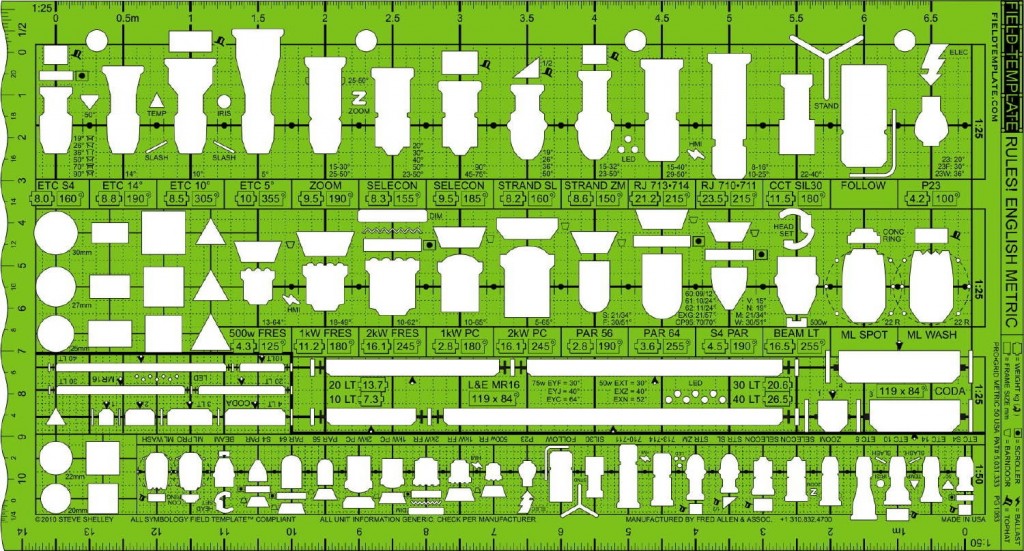
The METRIC RULES! Stencil is the latest offering from Field Template. Using the patented Pro•Grid Metric 50 system, all cutout lighting symbols are pre-spaced 50 centimeters apart and aligned onto a horizontal axis like a batten. Manufacturers include ETC, Selecon, Strand, Robert Juliat, CCT, L&E, Reich & Vogel, and even includes a favorite of many designers, the Strand Patt 23! Adjacent to every 1:25 cutout symbol is text displaying the metric weight, cut color size, and beam spread information for that symbol.
The METRIC RULES! Stencil also contains a substantial collection of ancillary symbols not found on any other template; LED dots, HMI indicators, dimming shutters, scrollers, top hats, half hats, along with several sizes of circles, rectangles, squares, triangles, and generic moving light symbols.
The METRIC RULES! Stencil is laid out so that every lighting and ancillary symbol is repeated in two scales—both 1:50 and 1:25. The scales are printed on either side of the template. ½” and ¼” scales are also printed on the scalloped edge of the template.
The METRIC RULES! Stencil is packaged in an A4 page format. Four cutout holes across the 1:25 edge allow it to snap into a 2-hole or 4-hole A4 binder. The top sticks out to act as a tab separator in the notebook.
For more information on Field Template, please go to www.fieldtemplate.com.
Field Template Releases New 1/2″ Striplight Placemat
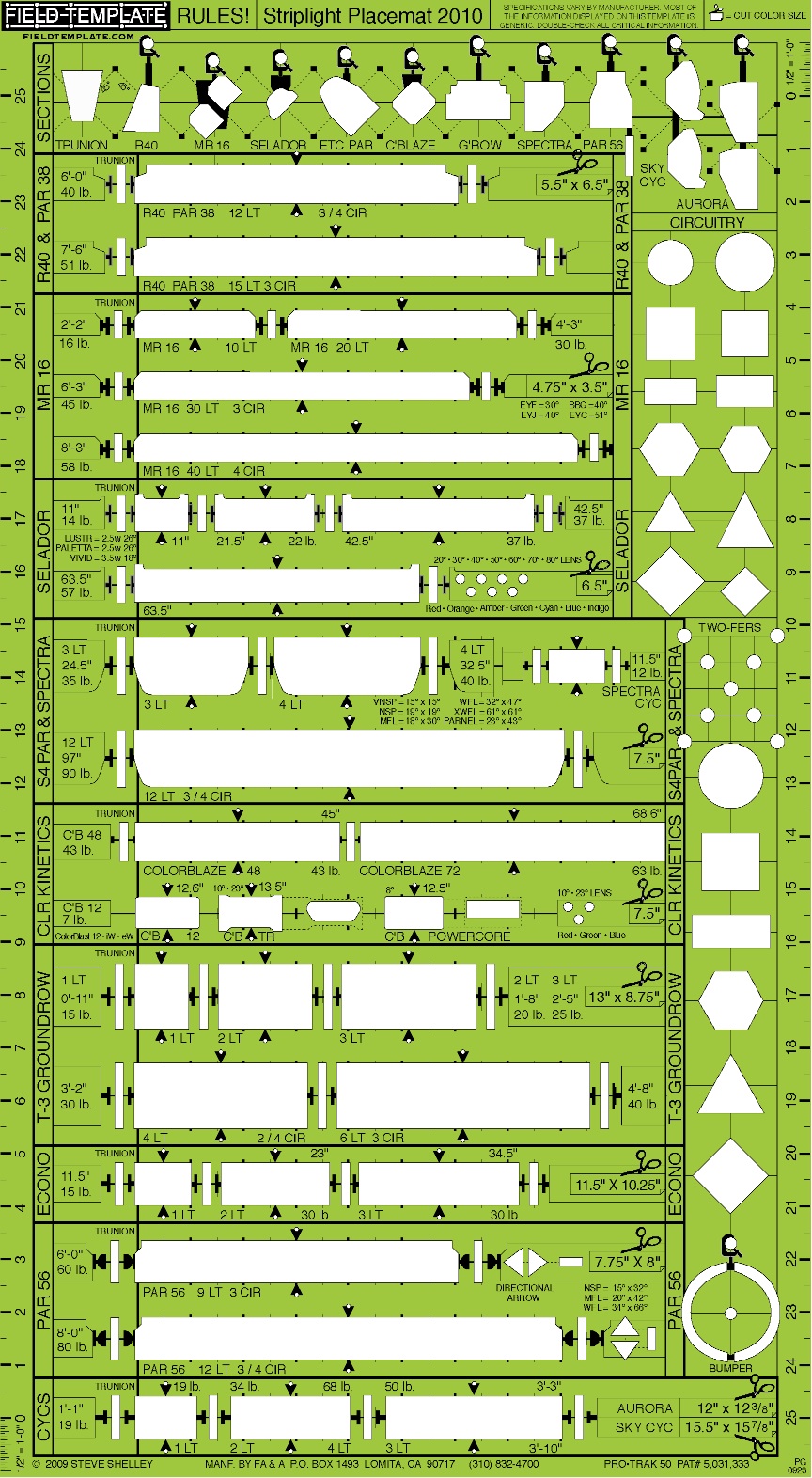 Steve Shelley, the owner of Field Templates sent me a note about his latest drafting template, the new 1/2″ Striplight Placemat. More from the Field Template Press Release:
FIELD TEMPLATE is proud to introduce the updated 1⁄2″ STRIPLIGHT PLACEMAT. Fresh off the grill, this template sizzles with the latest technology. Along with the latest ETC Source 4 MultiPARs, it’s got all the latest LED’s: Selador, Color Kinetics, and the Altman Spectra-Cyc. The 1⁄2″ Placemat also has today’s freshest standards; the Aurora, Econo-Cyc, and Sky-Cyc, as well as PAR-56, PAR-38, R40, and MR-16. There are section cutouts for every fixture type, as well as three sets of circuitry symbols, two-fer dots, and a scenery bumper. This potent parcel of plastic will be available for the USITT convention in Kansas City.
Yee-haw Buckaroos!
If you are not attending the USITT convention at the end of March or cannot wait till then to get your hands on the Striplight Placemat, visit Field Templates website at www.fieldtemplate.com.
Where is the Industry Heading – An Interview with Steve Shelley
This months Where is the Industry Heading Column is an interview with noted Lighting Designer and drafting symbol guru, Steven Shelley. In addition to Mr. Shelley’s design talents and drafting template genius, he has also found time to write a book for the lighting industry, A Practical Guide to Stage Lighting which just recently went into it’s second edition. Look for a review of Mr. Shelley’s latest book here on iSquint very shortly.
In regards to paperwork, how has that changed from when you started to where you are now?
Night and day. When I started it was legal pads and lots of mistakes. Copies were photocopies at best, or mimeographs. When I started at American Ballet Theatre, we used the new Macintosh computer and the application “Multiplan” to re-sort the paperwork.
What are your thoughts on LED’s in general for use within the industry?
Eventually they will pull even until the next source takes them over. Right now they are still pretty expensive. Yes, you get a great long-term bang for your buck, but for short rentals, they are still more in the “eye candy” genre as far as I can tell.
What challenges do you face with the ever changing console architecture?
It’s not easy to catch up. With all the different variations and new approaches, it seems that having a console operator fluent in the specific console is now more critical than ever before. While this is the nature of the beast on moving light consoles, it’s now becoming more prevalent on consoles solely utilizing conventional fixtures as well. While I can appreciate that, there are times of frustration when I can no longer figure out how to merely turn a fixture on. And neither can the newbie console operator.
Does 3D rendering provide a reliable method for developing a concept while designing out a production?
It may do so to illustrate a concept for a client. Otherwise I find it more time consuming than mentally producing the 3D rendering with mental images translated to my own notes and the light plot.
Do you feel that projection media is a form of lighting or should it be considered a separate field?
I think projection media is a form of scenography, and as such, a separate field. I have nothing but respect for projection specialists and, in the heat of a production period, I’m thrilled they are there to help collaborate on the piece, and assume the responsibility for the creation of that facet of the visual look for the show.
Looking back at a past production, how would you change it with some of the latest technology out on the market today?
In most cases, I would consider changing stuff on previous shows if it reduced the amount of power, cost, gear, load-in time, or replication time. In some cases that might be as simple as color changers; on other shows that might be replacement of specials with fewer lights and programmable mirrors. There are a few shows that I would consider swapping out gear for movers, but to do so would then potentially result in the need for more time to re-program the replacement units. In my experience, making these kind of changes must be carefully considered within the big picture, rather than as a quick-fix “knee-jerk” reaction.
What new or upcoming technology has the potential to change the lighting industry?
Right now it seems to be the light sources. No doubt, though, it will be something completely different than what anyone can postulate today.
What advice can you give to a beginner looking to make it in the industry?
Be polite. Smile. If you don’t have a passion for this, get out. Don’t hesitate to ask questions when you need to. Don’t feel like you deserve something; you will have to work for it.
Do you have any tech-table rituals or traditions?
Define the location of the tech table as soon as you walk in the door. Then they can be set up without waiting for your placement instructions. Always have a trash can to distinguish from archives. Pack up your stuff before the final tech; you don’t know how quickly the tables will need to be struck after the end of the rehearsal.
What is your favorite gel color and why?
Gam 850 among many many others. I like blue.
More about Steve Shelley
 Steve Shelley is a freelance lighting designer. He’s also the designer of the Field Template series of plastic drafting stencils, the Vectorworks toolkit SoftSymbols, and the author of “A Practical Guide to Stage Lighting, Second Edition” published by Focal Press. He lives in New York City.
You can find Mr. Shelley at most trade shows and conferences wearing the lime green cap, a smile and key chain versions of his popular Field Templates. You can find more information about Mr. Shelley and his templates at www.fieldtemplate.com.
Field Template Releases SoftSymbols V3 For Vectoworks 2010
 Seems like Steve Shelley has been quite the busy man lately. First he updates his book, A Practical Guide to Stage Light and releases his second edition. Now he releases his latest version of SoftSymbols Version 3 for uses with Vectoworks 2010.
SoftSymbols™ is a CAD-based theatrical lighting symbol package created in the VectorWorks® environment. Shelley designed the symbols with the patented icons used to create his award-winning series of Field Templates™.
Each hybrid symbol contains a Spotlight Light Info Record that lists default beam spread, color frame size, wattage, and candlepower information. SoftSymbols™ mimics the Spotlight structure—the symbols are organized in the same folders, and all the symbols are in 1/2” scale (if you’re drafting in metric, keep reading! Version 3 breaks the data scale code!) SoftSymbols™ is designed for Spotlight, and can be converted to AutoPlot.
SoftSymbols™ V3 includes
- Data Conversion Plug-ins, so that ONE SET of symbols can be used for either Imperial or Metric scales!
- SoftData©, a 92 page PDF spreadsheet displaying data extracted directly from every resource.
- Shelley’s Section Collection, the series of 2D symbols that exist no where else.
- More than doubles the number of symbols in other fixture libraries
- Has all the latest up-to-the-minute symbols
- Has web and phone contact info for every manufacturer
- Reflects complete manufacturer’s product lines
For more information or to purchase your copy of SoftSymbols V3, visit Field Templates website at www.fieldtemplate.com. The full version of SoftSymbols for Vectorworks 2010 runs $120. USD and is available for both the Mac and PC.